Introduction
This report will investigate the paterns of interaction between students in a learning analytics class' during an online discussion (based on two materials) using network analysis. The materials the students had to read/watch and comment on were a reading and a video.
The interactions between students were recorded on Perusall and included comments, upvotes and replies.
The following networks have been created using the Yifan Hu network model:
- A network based on interactions in the reading.
- A network based on interactions in the video.
- A (total) network based on interactions accross both the materials (video and reading).
Reading Network
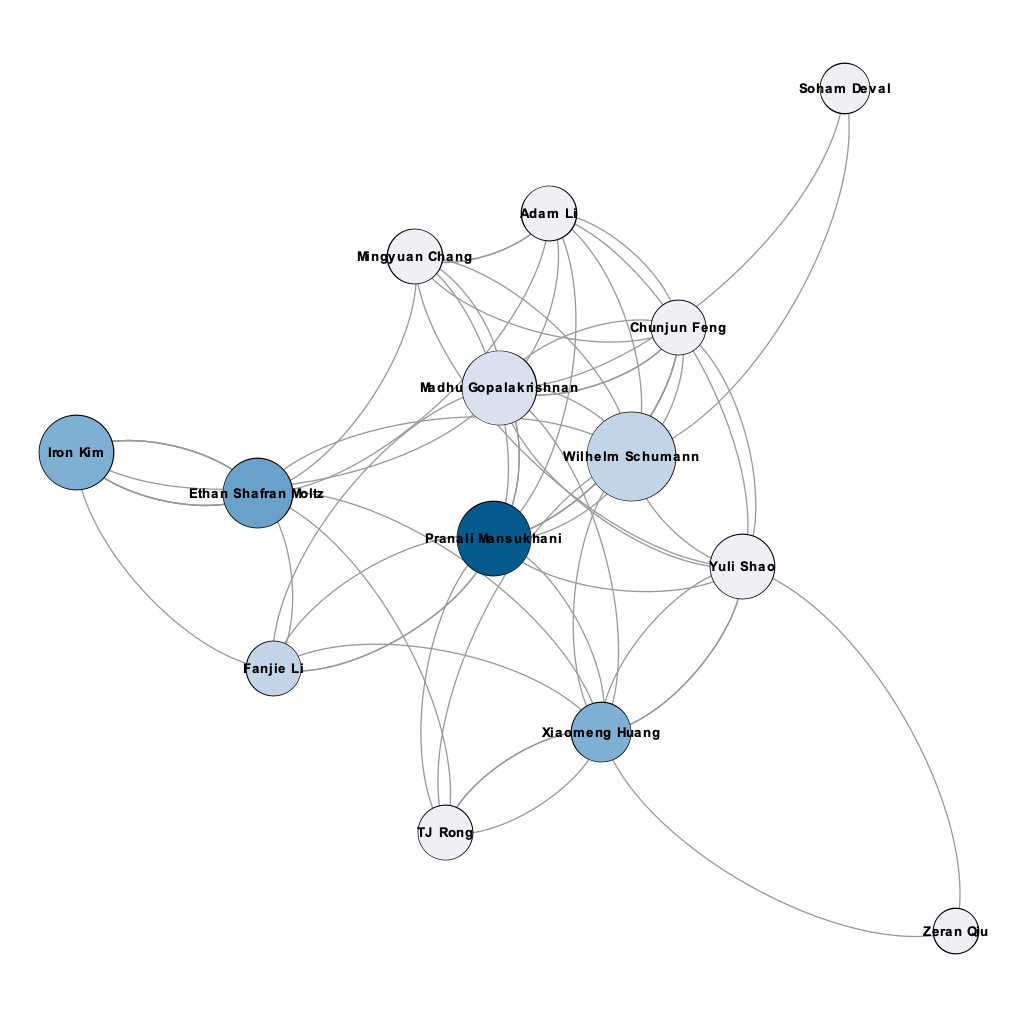

Key: The darker the circle, the more replies the student received on comments they made in the reading. The lighter the circle, the less replies a student received on comments made in the reading. (Pranali = 11, Zeran = 0)
Other Detail: The larger the node (or circle) the more comments a student made in the reading. (Wilhelm = 11, Zeran = 2).
Discussion
The lightest colour (near white) represents students who did not receive a reply on a comment. These include students like TJ and Zeran for example.
Based on the amount of comments they made and the amounts of replies recieced, we can see that Pranali, Ethan, Xiaomeng, Iron were very engaged. We can also see that also see that although Madhu and Wilhelm made many comments their received relatively few replies to their messages. (1 and 2 respectievly). The Yifan Hu network model has identified Pranali as the most central node and this makes sense as on average she had the most comments, replies and upvotes (8, 11 and 6).
Video Network
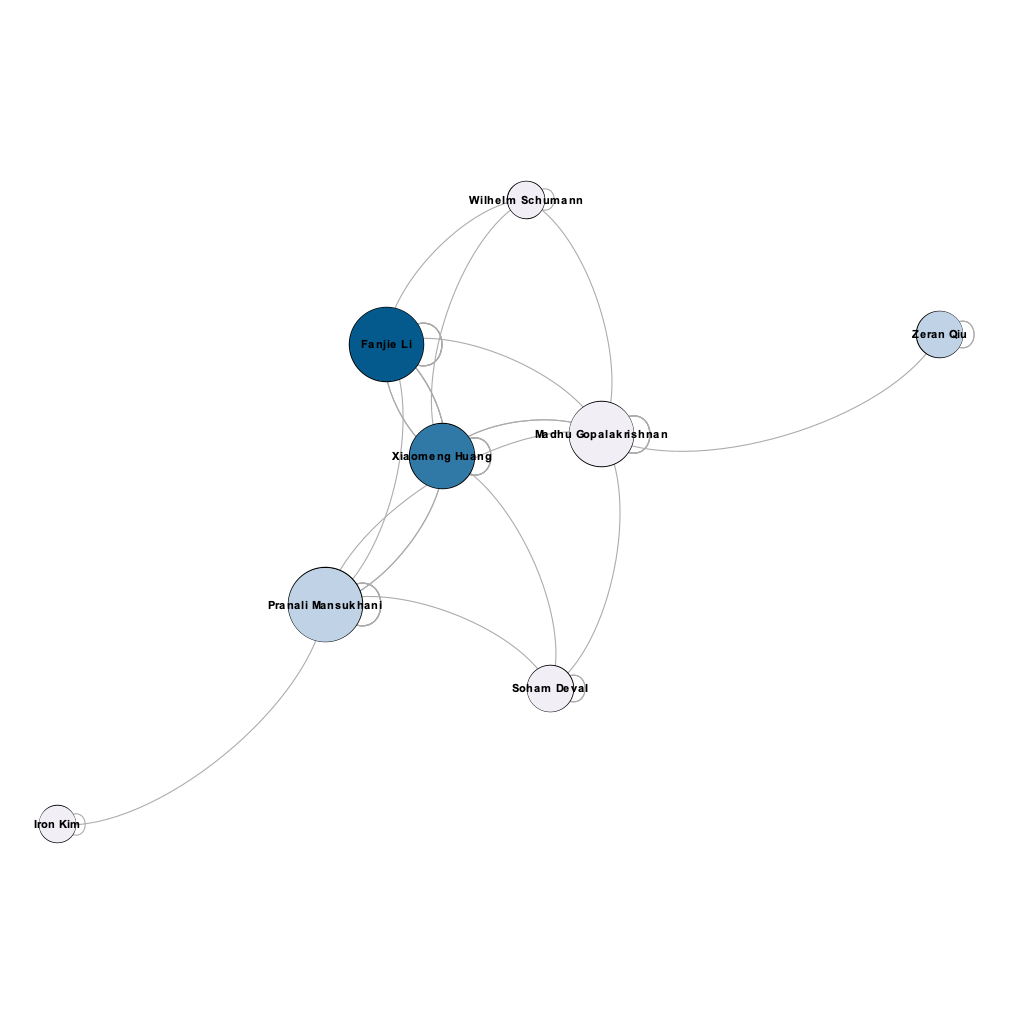
Key: The darker the circle, the more replies the student received on comments they made in the video. The lighter the circle, the less replies a student received on comments made in the video. (Fanjie = 5, Wilhelm, Soham, Iron and Madhu = 0).
Other Detail: The larger the node (or circle) the more comments a student made in the video. (Fanjie & Pranali = 5, Wilhelm & Iron = 1)
Discussion
As we can see this network is much smaller than the reading network. This is because there were students who did not comment, reply or upvote while watching the video. There could be a number of reasons for this, one being that the students are not required to engage in video discussions. It is merely encouraged. The readings on the other hand require students to engage. One can also argue that watching a video is a more passive vichicle for discussion, thus eliciting less engagement vs the reading where students have to attend to the text and the ideas it contains. In this small network we see that Fanjie and Xiaomeng are the most engaged and central. Fanjie made 5 comments, received 5 replies and received 6 upvotes. Xiaomeng made 4 comments, received 4 replies and 6 upvotes. Pranali also made 5 comments but only received one reply and 4 upvotes. Madhu was also relatively central, but did not receive many replies.
Total Network Over Both Materials
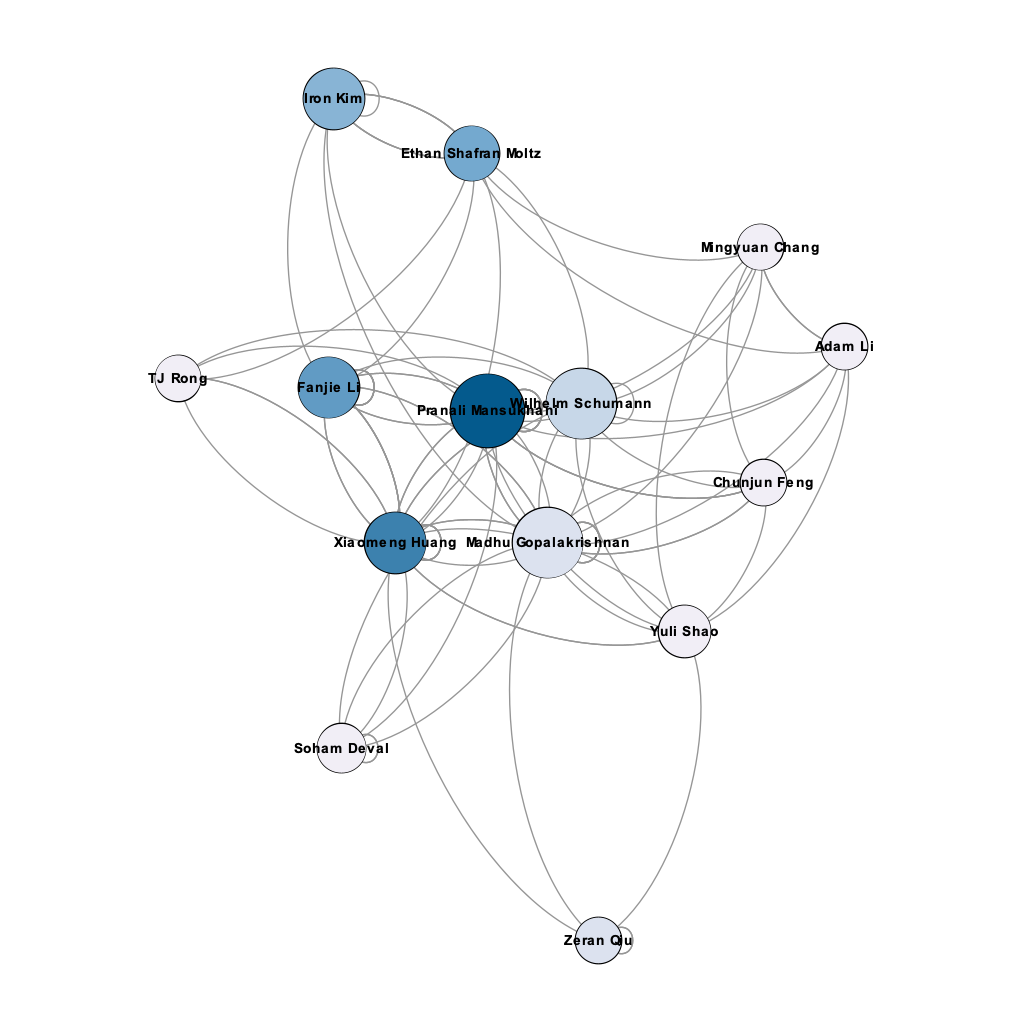
Key: The darker the circle, the more replies the student received in total. The lighter the circle, the less replies a student received in total. (Pranali = 13, TJ etc = 0)
Other Detail: The larger the node (or circle) the more comments a student made in total. (Pranali = 12, TJ etc 4).
Discussion
In this network we can see a combination of the two previous networks. In summary we can see that, according to the model , Pranali, Wilhelm, Madhu Fanjie and Xiaomeng are consistently seen as being very central to the network based on comments, replies and upvotes. However, when it comes to the quality of enagement, (measured by the ratio of comments to replies), we see that Pranali, Fanjie, Xiaomeng, Ethan, and (to a certain degree) Iron they perform consistently on this front. Although Madhu and Wilhelm are seen as central to the network, their comment to reply ratio is relatively low when compared to the group mentioned above. This could be an indication that their comments are less engaging or of poor quality. BUT it can also be because they made their comments late, meaning that no person was able to respond to their comments.
Conclusion
All in all we can see that a network model algorithm will render a newtork using nodes and edges as it sees fit. These networks are excellent places to start analysis, but it is up to the researcher to give the network context for it to mean anything. In the the examples above, if one had only provided the nodes without connecting their size to comments made and colour to replies received, one would have been inclined to say that Madhu and Wilhelm are very important nodes (top 4 at least), where they aren't really. They are, relatively speaking, but once we have some conext we realize that although they can be seen as "involved", "active", or "central" they are not necessarily the most important, or valuable nodes in these networks when it comes to quality of enagement. (Withing the context of online discusion).